Minnesota GOP Holds Moment Of Silence For George Floyd Lyncher
Minnesota GOP Holds Moment Of Silence For George Floyd’s Lyncher

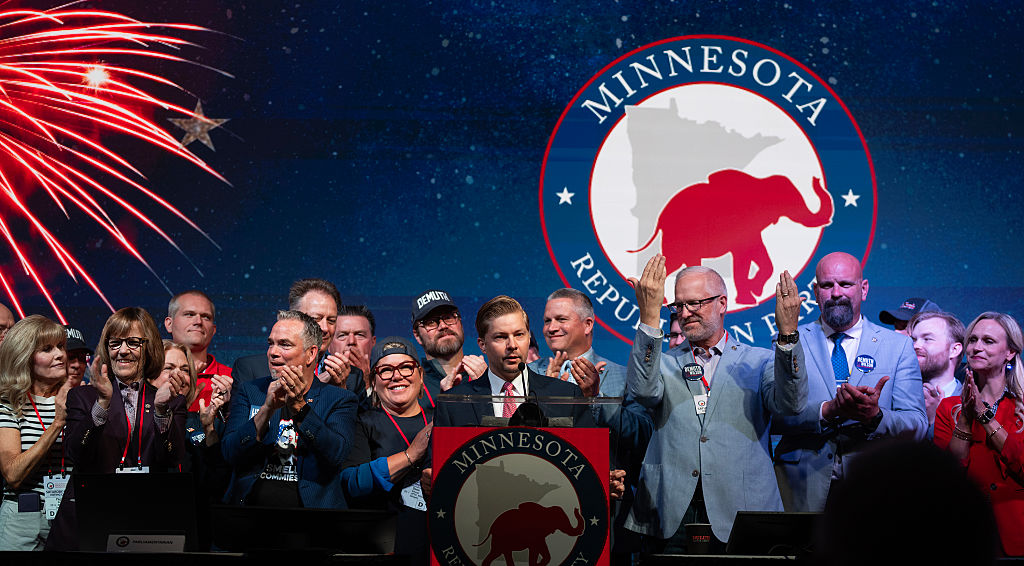
When I heard that members of the Minnesota GOP reportedly took a moment of silence for Derek Chauvin, who murdered George Floyd by crushing the breath out of him with his knee in May 2020, I did not think first of partisan politics.
I thought about Walter White.
In his 1929 essay “I Investigate Lynchings,” White, the legendary NAACP investigator who risked his life passing as a white man to document lynch mobs, recalled interviewing a white participant in the 1918 Georgia lynchings that included the murder of Mary Turner, a pregnant Black woman. I should note that a 10-year-old Black boy hiding in a corn field witnessed a group of white men shoot and burn Turner, split open her stomach with a hog knife, and crush the skull of her fetus after it fell to the ground. They marked her grave with a whisky bottle and a cigar.
“Little by little, he revealed the whole story,” White wrote. “When he told of the manner in which the pregnant woman had been killed, he chuckled and slapped his thigh and declared it to be ‘the best show, Mister, I ever did see. You ought to have heard the wench howl when we strung her up.’”
The “best show” he had ever seen. Umph.
That man did not speak with shame or horror. He remembered the lynching as pleasure and entertainment. This was a sadistic white man savoring the butchering of a Black woman and her unborn child as a spectacle and something to cackle over.
And that is why the Minnesota GOP’s moment of silence for Chauvin felt so familiar. Just days after the sixth anniversary of George Floyd’s public murder, which triggered international protests, the Minnesota Republican Party held its state convention in Duluth with more than 2,000 delegates in attendance. At some point, delegate Christopher Rocco from St. Paul brought the motion to the convention floor and called for a 30-second moment of silence for Derek Chauvin.
Rocco, who has filed to run for a state Senate seat, reportedly said, “I’d like to suspend the rules for a moment of reflection for Derek Chauvin.”
The convention chair, State Rep. Danny Nadeau, then put it to a voice vote, and the crowd approved it. The silence ended up lasting about 10 seconds.
While his Party tried to clean it up, Rocco later said Party leadership did not know about his plan ahead of time, and he explained that he called for silence: “Not because he died, but because the moment you are silent on injustice is the moment you are implicit in injustice.” He told the New York Times: “I made that decision to stand up for someone who doesn’t have the ability to stand up for himself anymore.” He also said that Chauvin “should get a state retrial” and “a federal pardon.”
You might be asking a series of questions: Why did this happen at all? What kind of politics makes people feel moved to bow their heads for Derek Chauvin? What kind of moral imagination hears that killer cop’s name and reaches for reverence? What kind of room understands a convicted murderer not as a shameful symbol, but as someone worthy of public sympathy?
Because they were not mourning Derek Chauvin, per se. They were identifying with him.
There is no need for us to split hairs over Christopher Rocco’s words or psychoanalyze his or his peers’ souls. That would require us to debase ourselves by traveling through such darkness I have no interest in dignifying as complexity. This collective reverence for Chauvin is evidence of a sick political culture that can watch a Black man die under a police officer’s knee while crying out for his mama, and still locate its grief in Chauvin’s 22-year prison sentence.
Their moment of silence is evidence of a ghoulish racial inheritance so old it feels almost epigenetic. It’s a reflex that excuses white violence, sanctifies the white punisher, and treats Black suffering as the natural price of order. Those 10 seconds of silence are evidence of a moral degeneracy that needs the killer to be innocent because admitting the truth would mean surrendering the fantasy that racist state-sanctioned violence is always righteous, and Black suffering is always deserved.
We need to stop pretending these racist ghouls emerged from nowhere. We are talking about the descendants of a culture of colonizers, slaveholders, the KKK, night riders, and lynchers. A culture where white folks of all classes gathered sometimes quietly, and sometimes by the thousands, to watch Black people be tortured, stabbed, burned, dragged, castrated, and hanged. A culture where people sliced flesh from Black bodies, passed severed genitals around as souvenirs, pawed through ashes for teeth and bones, sold pieces of the dead, preserved remains in jars, posed beside corpses, and mailed the photographs like vacation postcards.
That was not fringe behavior. That was civic life, a continuation of a centuries-old sadistic tradition that began in Europe before American colonization. That was family entertainment, bonding between white parents and children, and the formation and purification of the white community.
So when thousands of delegates gathered in 2026 to bow their heads for Derek Chauvin, we didn’t have to pretend we were witnessing some mysterious moral malfunction. We are seeing the afterlife of that culture. We are seeing the descendants of degenerates who learned to locate sympathy with the torturer, not the tortured; with the mob, not the victim; with the executioner, not the body begging for mercy.
That kind of inheritance does not disappear because the mob moves from the town square to a Republican convention hall. The sickness at the center of this moment is that those Republican ghouls decided to grieve accountability more than murder. And they represent the kind of old racial pathology that does not simply defend white violence after the fact, but gathers publicly to mourn when that violence is interrupted by consequence.
They may not say they want to be like the man Walter White interviewed back in 1929. They won’t admit that kind of appetite out loud. But their gesture belongs to the same sadistic racial lineage and moral sewer. Those delegates couldn’t stand on the convention floor and cackle, slap their thighs, call a 21st-century lynching of a Black man “the best show” they had ever seen, and savor the sound of him crying out “I can’t breathe” as he died. And so they had to mourn and send the message that Derek Chauvin is the one who deserves public reverence.
Chauvin, to them, is not simply a disgraced cop. He is a symbol of the world they want back. They want a world where white violence does not have to explain itself and where Black death can be blamed on Black existence.
SEE ALSO:
The NAACP Is Asking Black Teenagers To Save Black Voting Rights
SCSU Students Said No To A Racist Politician For Commencement Speech
Minnesota GOP Holds Moment Of Silence For George Floyd’s Lyncher was originally published on newsone.com


